The fracturing of European feminism: How TERF ideology threatens decades of progress
Women’s and LGBTIQ rights have advanced hand in hand across Europe for decades. But exclusionary movements within feminism now threaten that progress. Where trans and queer-exclusive feminism takes hold, both women’s and LGBTIQ rights lose ground—a stark reminder that solidarity is essential to protecting hard-won freedoms.
Long before the theorisation of intersectional feminism, the feminist and LGBTIQ movements shared close ideological roots. Though the relationship has never been entirely harmonious—traditional feminism often prioritised the voices of white, cisgender, heterosexual women—the thread connecting these causes has enabled marginalised groups to find common ground in challenging systemic oppression.
Both movements confront the same patriarchal structures, advocating for bodily autonomy, sexual freedom, reproductive rights, and protection from gender-based violence. Recent European Union legislation demonstrates this mutual influence clearly.
From directives to citizen action
Two EU directives issued in 2004, just eight months apart, illustrate the point: the Equal Treatment in Goods and Services Directive prohibited direct and indirect sexual discrimination in the provision of goods and services, whilst the Citizens’ Rights Directive guaranteed the right of EU citizens and their spouses or registered partners to move and reside freely across member states. The latter was upheld by the European Court of Justice in Coman v Romania (2018), ensuring enforcement even in countries that do not legally recognise same-sex partnerships.
More recently, the EU launched the LGBTIQ Equality Strategy in 2019 and the Gender Equality Strategy 2020-2025 the following year. In 2024, two significant European Citizens’ Initiatives—”My Voice, My Choice: For Safe and Accessible Abortion” and “Ban on Conversion Practices in the European Union”—each surpassed one million signatures.
Nordic leadership on women’s and LGBTIQ rights
Despite binding EU legislation, progress across member states remains uneven. Over recent decades, Nordic countries have led both European and global advancement in women’s and LGBTIQ rights, whilst Eastern European countries have struggled to keep pace. Six nations consistently stand out: Sweden, Denmark, Finland, Norway, the Netherlands, and Iceland. Yet as will emerge later in this article, the primacy of some of these countries is fragile and beginning to fracture, due to recent movements that have created divisions within feminist activism.
Their current status as among the safest countries for women and LGBTIQ individuals reflects both recent achievements and century-long efforts. Finland became the first European country to grant full political rights to women in 1906. Iceland enacted the first Equal Pay Act in 1961. Sweden became the first country to allow legal gender change in 1972, though not without controversy—the document rectification required mandatory sterilisation and sex reassignment surgery. Denmark legalised same-sex registered partnerships in 1989, and the Netherlands legalised same-sex marriage in 2001. Norway implemented a gender quota law in 2003, requiring at least 40 per cent female representation on publicly listed company boards. In 2014, Denmark became the first European country to introduce a gender self-determination model, allowing adults to change their legal gender without proof of surgery or psychiatric approval.
Parallel progress through joint advocacy
These milestones demonstrate how women’s and LGBTIQ rights have advanced in tandem. Second-wave feminism in the 1960s and 1970s led to divorce and abortion legalisation in eleven EU countries and—arguably not by coincidence—the decriminalisation of homosexuality in eight. During the 1990s and 2000s, father quotas in parental leave systems were introduced alongside workplace equality measures, coinciding with the depathologisation of homosexuality and the emergence of non-discrimination laws, such as the Netherlands’ 1994 Equal Treatment on Grounds of Sexual Orientation Act.
More recently, all these countries have adopted consent-based rape laws—a change that together with the Istanbul Convention and the aftermaths of the #MeToo movement have influenced other countries’ definitions of sexual violence, including Estonia, where reform is underway.
This interconnected progress was largely enabled by joint advocacy from feminist and LGBTIQ actors. In Sweden, ten organisations representing women’s rights, women’s shelters, and LGBTIQ rights collaborated in the Krafttag mot våldtäkter national campaign, urging the government to implement an action plan against sexual violence in 2010. Similarly, 30 Icelandic trans-feminist and queer organisations united during the 2023 Nationwide Women’s & Non-Binary Strike.
Estonia and the Baltics lag behind
Progress in women’s and LGBTIQ rights in Estonia and the Baltic states differs significantly from that in countries that joined the EU before 2004. Whilst women’s suffrage in 1918 and legalised abortion in 1955 under the Soviet Union predate many Western countries, homosexuality was decriminalized only after the collapse of the USSR, and LGBTIQ rights have only begun to advance in the last decade.
Legal recognition for same-sex couples is now present in all three Baltic states, and Estonia is the only Baltic country to legalise same-sex marriage, contributing to its primacy over Latvia and Lithuania in ILGA’s Rainbow Map in recent years. However, Estonia’s scores in the EIGE Gender Equality Index consistently show the lowest gender equality achievements among the three Baltic states, particularly in the power domain.
The Malta paradox: LGBTIQ rights without women’s equality
Malta presents a striking paradox: outstanding legal protection for LGBTIQ individuals alongside poor outcomes for women. The country has topped the Rainbow Map for the past decade due to forward-thinking policies on legal gender recognition, hate crime and hate speech, and family law. Yet its Gender Equality Index score falls below the EU average, and Malta remains the only EU country to maintain an absolute ban on abortion.
This discrepancy may reflect contradictory Catholic influence that opposes women’s rights whilst supporting trans rights, or a political strategy exploiting citizen inaction. The Malta case proves that whilst LGBTIQ and women’s rights often advance together on common ground, legal progress in one domain does not necessarily translate to holistic gender equality. What maintains the connection between these movements is intersectional activism, joint lobbying, and communities unwilling to compromise. Prioritising LGBTIQ rights at the expense of women’s rights means abandoning half the LGBTIQ community itself—plain ideological failure.
The TERF threat to intersectional feminism
Trans and queer-exclusive radical feminism (TERF) represents a recipe for failure. If marginalised communities do not advocate for one another, entrenched power structures certainly will not.
TERF ideology seeks gender equality whilst excluding trans women, based on the premise that—in the words of Yale University associate professor Serena Bassi and assistant professor Greta LaFleur—”gender is an ideological tool of deflection away from the everyday politics of ‘real’ women’s lives and the multiple forms of oppression they face due more or less exclusively to their embodiment.”
Western countries that spent decades building inclusive legislation now face opposition from within feminist movements themselves. Countries that led the world towards progress and inclusivity risk strong regression.
The UK’s equality score plummets
The UK offers a key example. Founded in 2017, Women’s Place UK (WPUK) successfully opposed proposed reforms to the Gender Recognition Act that would have simplified legal gender change by allowing trans people to self-identify without medical diagnosis or evidence. The organisation formed specifically to oppose these reforms, aiming to “defend sex-based rights of women” by excluding trans women from feminist discourse and actively antagonising their efforts towards smoother legal gender recognition.
ILGA’s Rainbow Map shows the UK’s equality score dropping from 75 per cent in 2017 to 45 per cent in 2025—the largest decline in that period—illustrating how internal feminist opposition can stall progress. TERF movements have flourished in a UK distancing itself from EU equality strategies.
Sweden’s feminist pioneers turn exclusionary
The problem extends beyond Britain. Sweden, previously highlighted as a pioneer of feminist and LGBTIQ rights policies, has seen the rise of TERF-aligned groups. The Swedish Women’s Lobby (SWL), established in 1997 as an umbrella organisation uniting 57 associations representing over 130,000 women and girls, now actively opposes the ‘pro-gender movement’. The SWL, which participated in the 2010 Krafttag mot våldtäkter campaign, this year launched the Women’s Platform for Action International, a far-right, anti-transgender association promoting “sex-based rights”.
Latvia threatens Istanbul Convention withdrawal
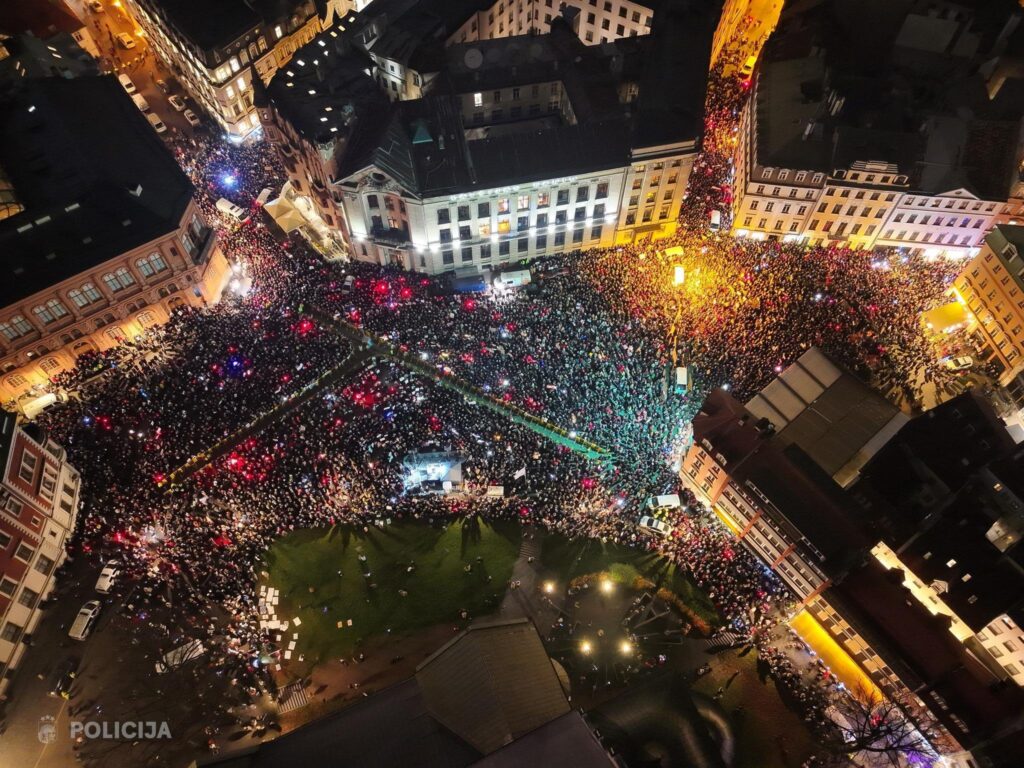
Latvia’s recent proposal to withdraw from the Istanbul Convention demonstrates the fragility of established protections and how populist political strategies can threaten rights often taken for granted. Whether the proposal passes in 2026 or is discarded, it underscores the ongoing need not only to advance equality but to safeguard minimum baselines.
The potential withdrawal is closely tied to TERFism and rejection of the concept of gender articulated in Article 3 of the Convention: “the socially constructed roles, behaviours, activities and attributes that a given society considers appropriate for women and men.” The message is stark: rather than accept the definition of gender and acknowledge that the root cause of violence against women is gender inequality, Latvia appears to be willing to relinquish protection from gender-based violence entirely—for every victim.
No freedom without solidarity
From an intersectional perspective, neglecting either the LGBTIQ or feminist struggle means losing both. There is no freedom for women without freedom for queer and trans women, and no freedom for the LGBTIQ community without gender equality. Supporting only one movement is political failure—it distracts with partial reward whilst sacrificing the rights and freedoms of many.